

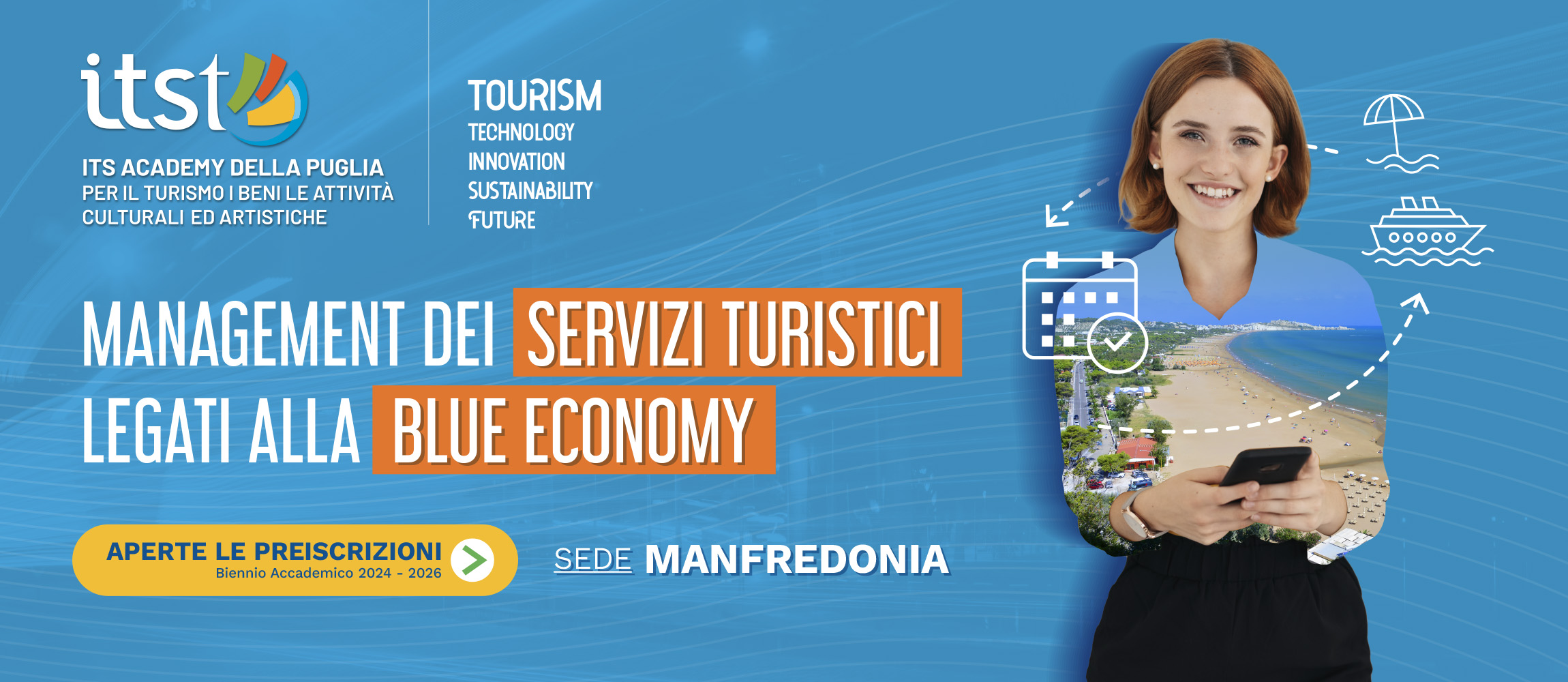
ITS Course “Management of tourism services related to the blue economy”
Planned location: Manfredonia – Biennium 2024-2026
Territorial declination: national figure “9.1.1 Higher technician for the design, development and promotion of the tourism supply chain”
Context
the 11th National Report on the Sea Economy overturns the traditional way of looking at the territorial processes of development in our country and redesigns North-South relations. In the south of Italy, in fact, the national growth of the ‘blue’ entrepreneurial fabric has more than doubled. Accommodation and catering services and sporting activities together account for 63% of the total enterprises in the ‘sea system’ and are also those with the highest incidence of female entrepreneurship.
In Apulia, the sea economy accounts for 4.9% of the total regional economy. This is the sector where there is a particularly high demand for young people up to 29 years of age, compared to which there is still a strong mismatch that concerns about a quarter of the sought profiles.
Faced with the development of the port sector, the evolution of boaters’ needs and the new technologies available, and the awareness that the port must represent an element of connection and integration with the surrounding area, this ITS course aims to train technicians with knowledge and skills aimed at enhancing both the sea and the beauty of villages, coastlines, beaches and climate; they have to be aware of both the importance of the active and driving role demanded of local operators and the value of a highly professional reception focused on meeting tourists’ expectations.
Professional profile
the ITS course aims to train a professional able to provide the best services to pleasure boaters and passengers of ferries and cruise ships. The profile interfaces with the various entrepreneurial realities within the port and the authorities in charge of transit, interact with the boat client and coordinates with the other technical figures operating in the port and in the accommodation and tourist facilities in the surrounding area. The professional orients the client within the services that a port typically provides to the boater, directing them not only to port services (mooring, maintenance, repairs, provisioning of the galley, with attention to the offer of the port and the territory in terms of businesses, services and related quality standards) but also to local accommodation and cultural facilities, tourist attractions, typical products, places to visit, restaurants, shops, leisure facilities and tourist guides of the territory.
Skills
Participants will be able to:
- Assist the customer in taking advantage of the available tourist opportunities and services, using a communicative style appropriate to the relationship (also in foreign languages), identifying solutions and product/service proposals customised to the boater’s needs
- Take care of integrated information systems (physical and virtual notice boards)
- Inform about rates, new tourism products and any favourable offer conditions
- Measure the degree of customer satisfaction using appropriate survey tools (predefined forms, web-based systems, etc.)
- Interact with the multiplicity of partners and tourism service providers by defining terms and conditions for collaboration
- Contribute to the qualification of tourist services offered in a logic of integrated enhancement of territorial resources.
- Nautical service companies or ferry and/or cruise passenger port terminals
- Public and private airport facilities
- Pleasure boating service facilities
- Accommodation, hotels and non-hotels
- Public and private facilities dedicated to reception, tourist information and management of tourist services
- Tour operators, travel agencies and brokers, tourist reservation centres
- Cruise ships, airports, ports, stations and villages
- Sports associations related to nautical tourism
- MICE agencies and events aimed at the enjoyment of boating and sea-related sports
- Web marketing and web & mobile communication agencies
The course lasts 2000 hours in total, distributed over two years and divided as follows:
– 1200 hours dedicated to classroom laboratory teaching, case studies in the laboratory and/or in work contexts, seminar activities, educational and study visits, project work;
-800 hours of internship activities in work contexts.
The daily timetable will be determined on the basis of the operational program and may vary from 5 to 8 hours.
Attendance is mandatory for at least 80% of the training activities, under penalty of exclusion from the final exam which will be held in accordance with the methods established by the Ministry of Education.
At the end of the course, by passing the final exam, the DIPLOMA OF HIGHER TECHNICIAN issued by the Ministry of Education and Merit is obtained, corresponding to the 5th LEVEL of the European Qualifications Framework for Lifelong Learning (EQF), pursuant to art. 8, paragraph 1, of the Prime Ministerial Decree of 25 January 2008.
Where the requirements are met, and in relation to the specificity of the study program, students will acquire the skills aimed at taking the exam tests for the following certifications:
Certifications for the use of specific sector software
Foreign language certifications according to the levels of the CEFR (Common European Framework of Reference for Languages)
Certifications relating to safety in the workplace


