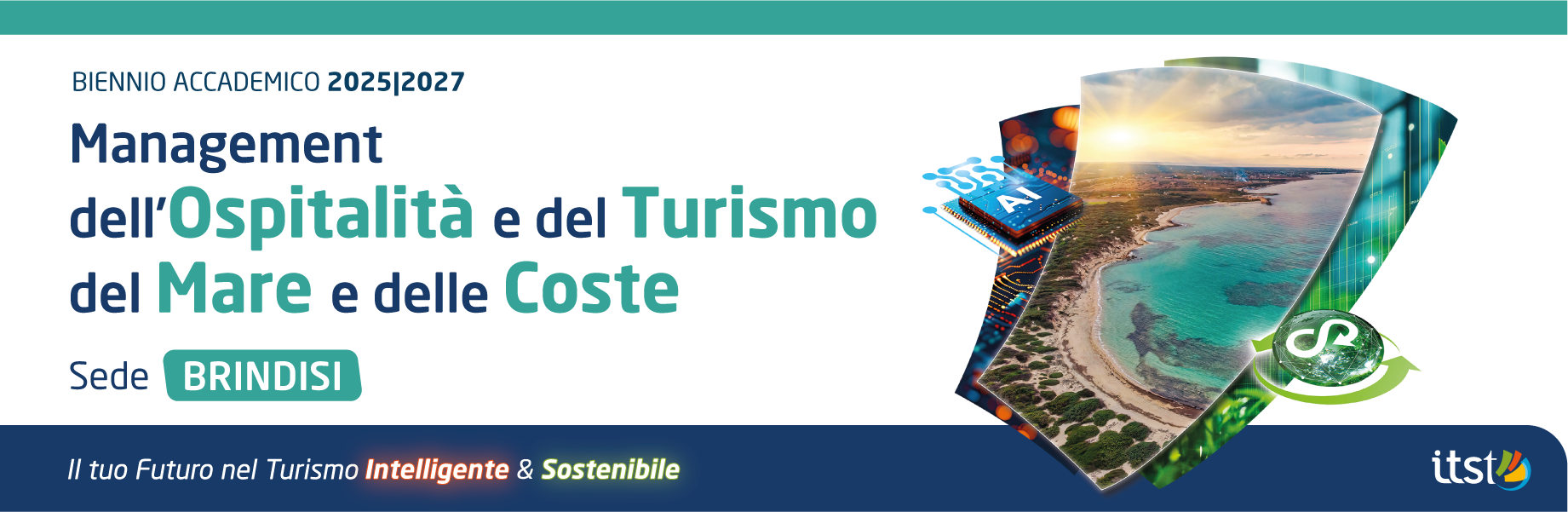
Hospitality and Coastal & Marine Tourism Management
Location: Brindisi (BR)
Academic Biennium: 2025–2027
National Figure: 9.1.2 Higher Technician for the development of supply management processes of the tourism and cultural supply chains
Program Overview
The highly specialized program in Hospitality and Coastal & Marine Tourism Management aims to train a cross-sector professional capable of developing an integrated experiential offer and contributing to the competitiveness of coastal destinations.
Context
The context of the Hospitality and Coastal & Marine Tourism Management course is the Blue Economy, currently one of the most dynamic sectors within tourism in Italy. Accommodation and food services alone account for 29.1% of the total added value in the marine economy. In this context, Puglia stands out as a strategic tourism hub focused on integrating sea, hospitality, and culture. There is growing interest in marine ecotourism and experiences related to sailing, windsurfing, and scuba diving. Ports and marinas are no longer just transit points but places of experiences and opportunities.
Professional Profile
The professional profile emerging from the course in Hospitality and Coastal & Marine Tourism Management is a specialist capable of designing and coordinating tourism and hospitality offers in coastal areas, with an integrated vision that combines hospitality, sustainability, digital marketing, and strategic service management. They work on creating authentic and personalized territorial offers that support sustainable enjoyment of the area. Moreover, the professional promotes competitive development and the deseasonalization of maritime destinations.
What you will learn
During the course in Hospitality and Coastal & Marine Tourism Management, you will learn the following key skills:
- Manage marine hospitality facilities, coordinating staff and supervising service quality
- Promote destinations through territorial and digital marketing strategies
- Collaborate with public institutions and private stakeholders
- Apply revenue management techniques, digital pricing, and omnichannel promotion
What you will study
During the course in Hospitality and Coastal & Marine Tourism Management, you will study:
- Monitoring of tourism phenomena and the reference territorial system
- Organization, management, and supervision of departments/services in tourism and hospitality facilities
- Design and preparation of integrated territorial tourism offers
- Management of relationships with clients, suppliers, and local stakeholders
Career opportunities available after the course in Hospitality and Coastal & Marine Tourism Management include:
- Hotel and non-hotel accommodation businesses, including those linked to nautical tourism
- Web marketing and digital communication agencies
- Travel agencies and tour operators, including those specialized in marine tourism
- Sports associations and nautical centers promoting water sports
- Service companies for recreational boating and tourist ports
- DMOs, tourism consortia, and business networks for territorial promotion
- Cruise ships, resorts, tourist villages, and hospitality structures
- 1080 hours dedicated to classroom laboratory teaching, laboratory case studies and/or work placements, seminars, educational and study visits, project work;
- 720 hours of internship activities in work contexts
The daily schedule will be determined based on the operational program and may vary from 5 to 8 hours. Attendance is mandatory for at least 80% of training activities, under penalty of exclusion from the final exam which will be held in accordance with the procedures established by the Ministry of Education and Merit.
Upon completion of the program, and after passing the final exams and evaluations, participants will be awarded the Specialization Diploma in Applied Technologies – EQF Level 5 (European Qualifications Framework for Lifelong Learning).
The diploma is issued by the Italian Ministry of Education and Merit together with the Europass Diploma Supplement. It is valid throughout the national territory and recognized for access to public competitions.
Where applicable, and depending on the specific area of study, students will acquire the competencies required to take certification exams for the following:
- Certifications for the use of industry-specific software
- English and second foreign language certifications according to the CEFR levels (Common European Framework of Reference for Languages)
- Certifications related to occupational health and safety
- HACCP Certification
- Advanced EIPASS certification, upon passing the exam (ITS acts as a certifying body)
The ITS program is also valid for participation in ITP (Technical and Practical Teacher) competitions starting from 2025 and for roles in Public Administration.
Partner