

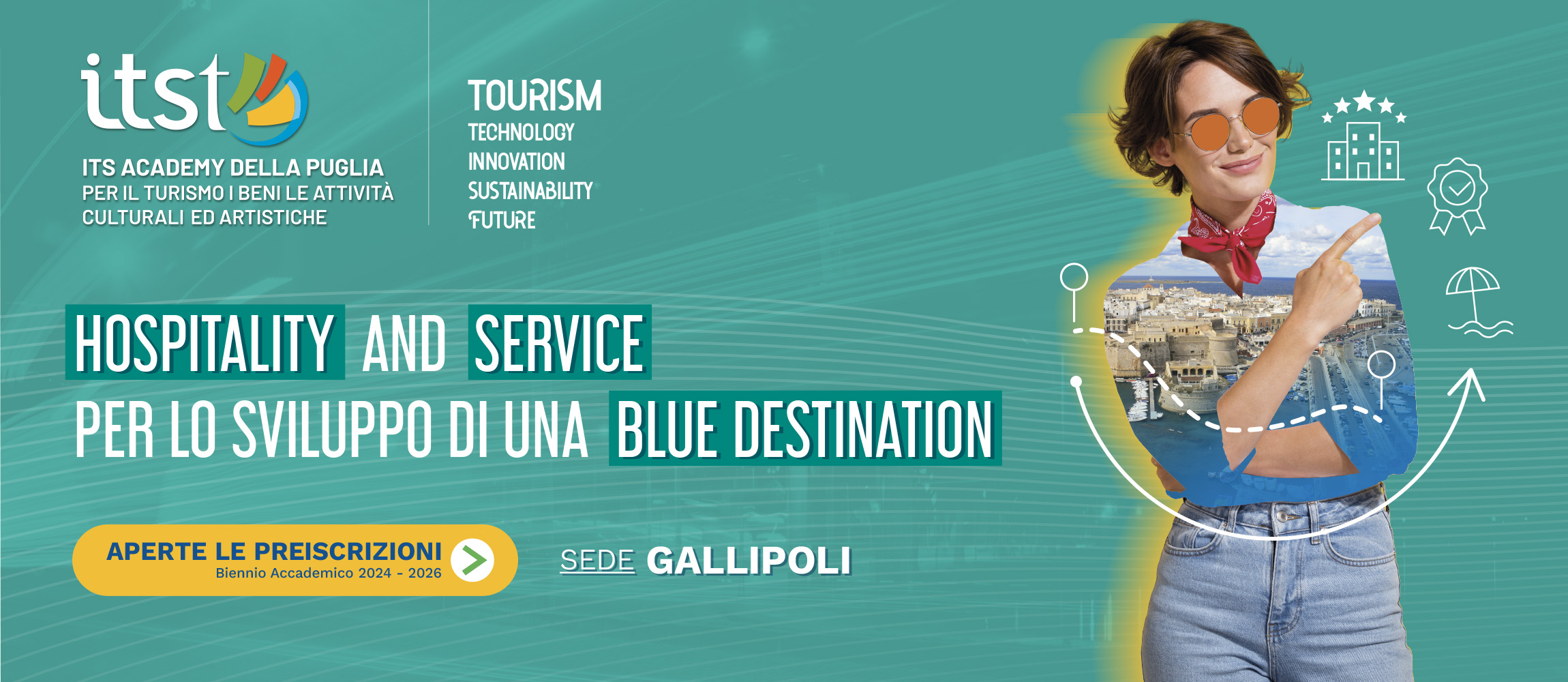
ITS course “Hospitality and Services for the Development of a Blue Destination”
Planned Location: Gallipoli (LE) – Biennium 2024-2026
Territorial declination: 9.1.1 national figure “9.1.1 Higher technician for the design, development and promotion of the tourist supply chain”
Context
The Italian maritime economy is valued at 161 billion euros and represents a resilient economy that increasingly contributes to the creation of Italian wealth, accounting for 9.1% of the entire national economy. Among the seven sectors that are part of the Maritime Economy, accommodation and catering services, including those on ships, as well as sports and recreational activities that encompass tourism-related activities in the field of sports, entertainment and leisure, stand out. In Southern Italy, the growth of the “blue” entrepreneurial fabric has more than doubled the national rate, with a 63% incidence on the total number of companies in the “Sea System.” In this sector, there is a particularly high demand for young people up to 29 years old, facing a strong mismatch that concerns about a quarter of the sought profiles. Apulia, with more than 1000 km of coastline, requires operators who can formulate proposals related to the sea and tourist port activities and who possess knowledge and skills aimed at enhancing both the sea and the beauty of villages, coasts, beaches and climate. These operators must be aware of the importance of the active and driving role requested from local operators and the value of highly professional hospitality focused on meeting tourists’ expectations.
Professional profile
The ITS course “Hospitality and services for the development of a blue destination” aims to train a profile with extremely versatile tasks, all directed towards providing the best services to recreational boaters, nautical tourists and passengers of ferries and cruise ships. This profile will guide them not only to port services but also to the area’s accommodation and cultural facilities. They may also manage hospitality in the “boat and breakfast” format, ensuring essential or luxury comfort levels according to the client’s needs and economic means. Additionally, the Technician will deepen their knowledge and techniques related to creating a high-quality and competitively valuable tourist and cultural offer, emphasizing the integration between port and territory, with structured skills for digital marketing actions, in an approach aimed at developing “community” type destinations.
Skills
Participants will be able to:
- assist clients in utilizing available tourist opportunities and services, employing an appropriate communication style (including in foreign languages) and identifying personalized product/service solutions based on the boater’s needs
- maintain integrated information systems (both physical and virtual notice boards)
- provide information about rates, new tourist products, and any favorable conditions of the offer
- measure customer satisfaction using specific detection tools (predefined forms, web-based systems, etc.)
- interact with a variety of partners and service providers, defining terms and conditions for collaboration
- contribute to the qualification of tourist services offered, with a view to the integrated enhancement of territorial resources
- organize activities and events, including sports activities, related to the enjoyment of the sea (e.g., regattas, scuba diving, etc.)
- support the management of hospitality forms centered on the enjoyment of the sea and related events/services
- Companies providing services for nautical activities or passenger ferry and/or cruise ship terminals
- Public and private airport facilities
- Services structures for recreational boating
- Accommodation structures, including hotels and non-hotel facilities
- Public and private structures dedicated to hospitality, tourist information and the management of tourist services
- Tour operators, travel agencies and intermediaries, and tourist booking centers
- Cruise ships, airports, ports, stations and resorts
- Sports associations related to nautical tourism
- Agencies in the MICE sector and events aimed at the enjoyment of nautical activities and marine sports
- Web marketing agencies and web & mobile communication agencies
The course lasts 2000 hours in total, distributed over two years and divided as follows:
– 1200 hours dedicated to classroom laboratory teaching, case studies in the laboratory and/or in work contexts, seminar activities, educational and study visits, project work;
-800 hours of internship activities in work contexts.
The daily time will be determined on the basis of the operational program and may vary from 5 to 8 hours.
Attendance is compulsory for at least 80% of the training activities, under penalty of exclusion from the final exam which will be held in accordance with the methods established by the Ministry of Education.
At the end of the course, by passing the final exam, one obtains the SUPERIOR TECHNICIAN DIPLOMA issued by the Ministry of Education and Merit, corresponding to the 5th LEVEL of the European Qualifications Framework for lifelong learning (EQF), to pursuant to the art. 8, paragraph 1, of the Prime Ministerial Decree of 25 January 2008.
Where the requirements are met, and in relation to the specificity of the field of study, students will acquire the skills aimed at taking the exam tests for the following certifications:
Certifications for the use of sector-specific software
Foreign language certifications according to the CEFR levels (Common European Framework of Reference for Languages)
Certifications relating to safety in the workplace


