

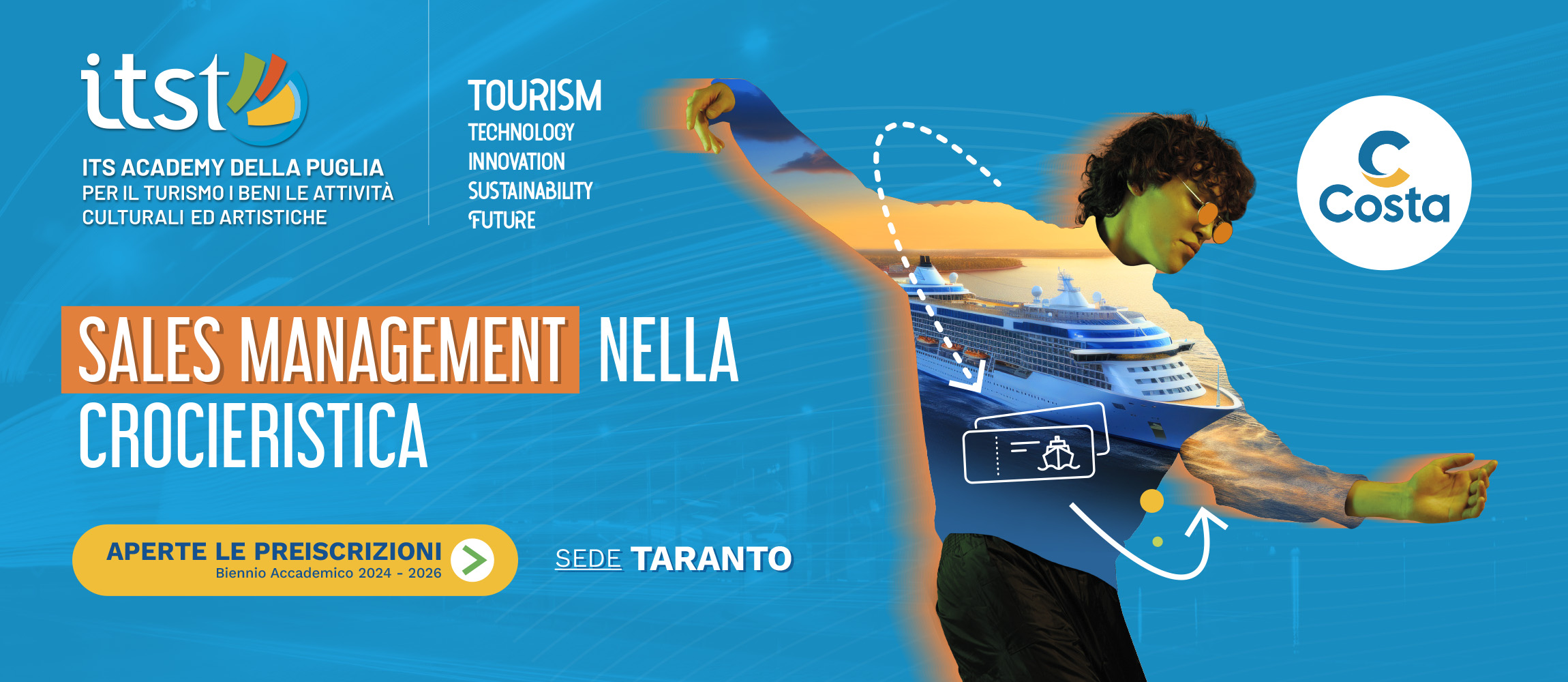
ITS Course “Sales Management in Cruise Industry”
Planned location Taranto – Biennium 2024-2026
Territorial declination: national figure “9.1.4 Higher technician for the management of guest support services”
Context
the phenomenon of cruise tourism has been expanding continuously for at least twenty years and, despite the difficulties related to the pandemic, the cruise industry has managed to fill the gap generated in 2020. Growth based on business fundamentals, which are strengthened: leading corporate groups, construction sites, areas of employment, commercial resources and major ports. The recovery of the cruise sector in 2023 made it possible to exceed the share of 30 million customers on board worldwide and further growth is expected for 2024. Puglia is confirmed as the Adriatic “queen”, absorbing 6.6% of passenger movements and 7.2% of national calls. The port of Taranto, in particular, was recognized as the best destination for cruise ships in 2022, and in 2023 the Ionian capital chosen as a turn-around stopover, i.e. a point of embarkation and disembarkation for passengers, and Costa Cruises will stop in Taranto in 2024 with Costa Fascinosa, as part of the exciting Mediterranean itinerary that touches the Greek islands, Malta and Italy, also stopping in Catania, Valletta, Mykonos and Santorini.
The trend towards the expansion of tourist activities related to ports and cruises translates into the need for professionals who can operate within the crews of cruise ships with tasks of reception, information, entertainment, customer management and the various departments involved in the provision of customer services.
Professional profile
the ITS course “Sales management in cruise industry” is carried out by the IOTA Foundation in close synergy with the Costa Cruises shipping company. Hospitality on structures of excellence, such as cruise ships, is therefore the focus of the profile focused on techniques, tools, skills as well as specialized knowledge relating to the “cruise” sector and more generally to the different forms of tourist hospitality. It is a figure who has a systemic vision of reception on board and is able to manage relationships with other subjects in charge of tourist services both inside and outside the ship. The profile is able to use automation and digital in order to oversee all the management processes of hospitality (Administration and Front Office, Marketing, Customer Care) with skills and autonomy in the management of devices and tools, which allow him to combine the traditional art of hospitality with the continuous technological upgrading of the tourism system, intervening in the processes of production, management and control of goods and services, developed in technologically advanced work contexts.
The profile will be further characterized in the second year of the Course, when participants will be able to opt for a specialization in “Future Cruise Consultant” responsible for the sale and promotion of future cruises aimed at guests on board the ship or, alternatively, in “Tour Expert” who is the focal point of the excursions offered within the cruise itinerary and transfers to guests the passion for discovering destinations, their history, art and culture.
Skills
The ITS course is carried out in partnership with Costa Crociere Spa and aims to provide the skills to:
- take on operational roles “on board” by integrating and interacting with the context through effective communication, even in a foreign language
- work in a team and networking thanks to acquired intercultural skills
- use the professional techniques related to the role and recognize and manage the company procedures related to it in the field of hospitality on cruise ships and more or less traditional forms of accommodation
- meet the demand for tourism and, in particular, for the cruise industry
- play the role of trait-d’union between the cruise ship guest and the company’s sales department
- promote activities and special offers for guests
- use new digital technologies for the communication of the offer, for example virtual tours and augmented reality
- intervene in the processes of production, management and control of goods and services, developed in technologically advanced work contexts
- enhance the territorial heritage from an entrepreneurial perspective and for the development and deseasonalization of the tourist offer, according to the new trends of experiential use (augmented reality, virtual reality, mobile use devices, etc.).
PARTNER

although operating mainly in favor of cruise operators, the student leaving the course will also be able to work in other activities that carry out services for tourism:
- accommodation facilities in the management of reception services and the provision of services to customers
- for the enhancement of the territory in a logic of blue economy, i.e. that relationship of port-territory integration aimed at creating value for boaters and nautical tourists
- public and private organizations that organize initiatives to discover the sea and its opportunities (itinerant exhibitions, tastings, workshops, show cooking to learn about and appreciate products and culture related to the sea, etc.)
- various types of tour operators and travel distribution (tour operators and travel agencies)
- tourist facilities, consortia and aggregations of operators for the promotion and marketing of the tourist offer
The course lasts 2000 hours in total, spread over two years and divided as follows:
– 1200 hours dedicated to classroom laboratory teaching, case studies in the laboratory and/or in work contexts, seminar activities, educational and study visits, project work;
– 800 hours of internship activities in work contexts.
The daily timetable will be determined on the basis of the operational program and may vary from 5 to 8 hours.
Attendance is mandatory for at least 80% of the training activities, under penalty of exclusion from the final exam which will be held in accordance with the methods established by the Ministry of Education.
At the end of the course, by passing the final exam, the DIPLOMA OF HIGHER TECHNICIAN issued by the Ministry of Education and Merit is obtained, corresponding to the 5th LEVEL of the European Qualifications Framework for Lifelong Learning (EQF), pursuant to art. 8, paragraph 1, of the Prime Ministerial Decree of 25 January 2008.
Where the requirements are met, and in relation to the specificity of the study program, students will acquire the skills aimed at taking the exam tests for the following certifications:
Certifications for the use of specific sector software
Foreign language certifications according to the levels of the CEFR (Common European Framework of Reference for Languages)
Certifications relating to safety in the workplace


