

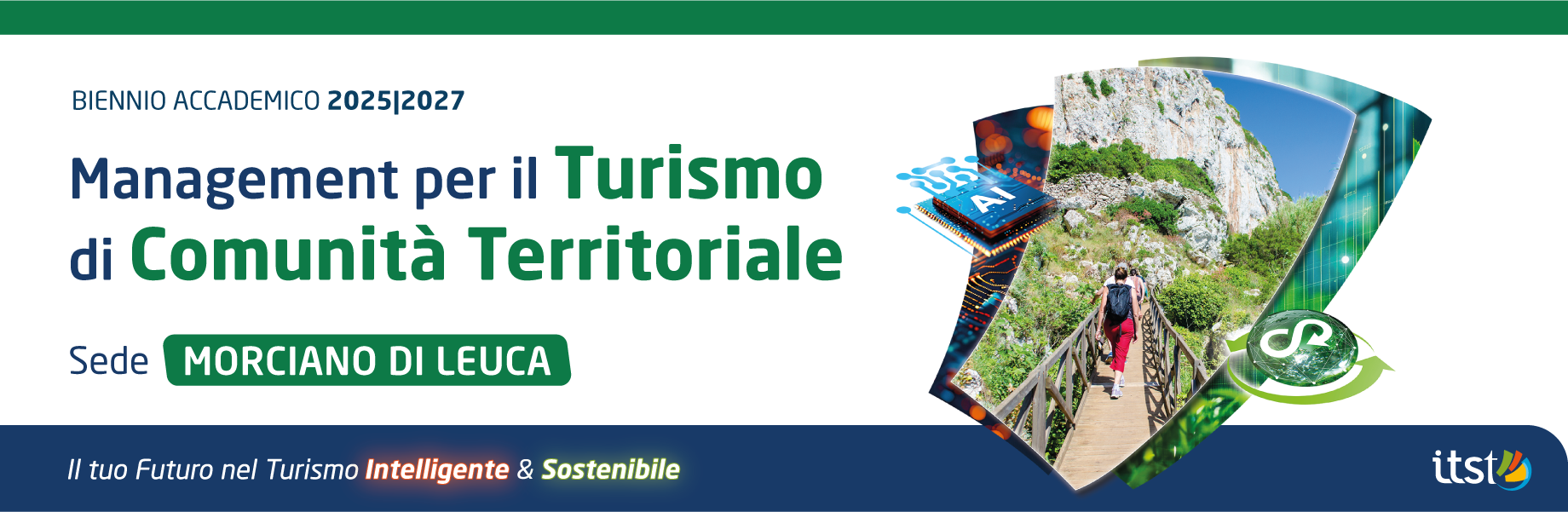
Territorial Community Tourism Management
Location: Morciano di Leuca (LE)
Academic Biennium: 2025–2027
National Figure: 9.1.1 Higher Technician for the design, development and promotion of the tourist supply chain
Program Overview
The highly specialized program in Territorial Community Tourism Management aims to train professionals capable of designing and managing inclusive, sustainable, economically stable and socially generative hospitality initiatives.
Context
Traditional seasonal, coastal tourism is giving way to a new model based on the three new S’s: social, sustainable, and solidarity-driven tourism. Travelers are increasingly engaged in regeneration and active experiences. At the same time, many people cannot afford a week of vacation annually, making it necessary to create a transversal tourism offer, inclusive of disadvantaged groups, youth, families, seniors, and people with disabilities. This program responds with a new professional figure able to deliver an inclusive and sustainable tourism offer.
Professional Profile
The professional emerging from the Territorial Community Tourism Management course operates in social, slow, cultural, nature-based and relational tourism. They work as designers and coordinators of tourism initiatives generating economic, cultural, and social value. They are proficient in digital and communication tools and able to analyze evolving tourism needs. This professional is a changemaker, fostering integrated territorial governance and enhancing the synergy between culture, environment, and collaborative economies.
What you will learn
Within the Territorial Community Tourism Management course, students will acquire the practical skills and knowledge needed to create and manage sustainable and inclusive tourism experiences, including how to:
- Create synergies between hospitality and local territory
- Regenerate properties and public spaces
- Support projects in assisted, sports, cultural, and nature tourism
- Design accessible tourism paths for youth, families, people with disabilities or temporary frailty, and seniors
What you will study
The curriculum of the Territorial Community Tourism Management program focuses on building core competencies for working in community-based tourism contexts. Students will explore:
- Analysis and monitoring of tourism phenomena
- Organization and management of tourism and hospitality services
- Managing relations with clients, suppliers, and territorial stakeholders
- Designing and setting up tourism offerings for social and community tourism
Graduates of the Territorial Community Tourism Management program will be qualified to work in a wide range of tourism and hospitality organizations focused on inclusive and community-based experiences, such as:
- Hospitality and lodging businesses (hotels and non-hotels)
- Travel agencies and tour operators promoting educational, social, and wellness packages
- Non-profit organizations organizing social, inclusive, and accessible travels
- Public and private entities offering information, booking, and hospitality services
- DMOs and tourism consortia facilitating the match between services and specific audience needs
The course lasts 1800 hours in total, distributed over two years and divided as follows:
– 1080 hours dedicated to classroom laboratory teaching, case studies in the laboratory and/or in work contexts, seminar activities, educational and study visits, project work;
– 720 hours of internship activities in work contexts.
The daily timetable will be determined on the basis of the operational program and may vary from 5 to 8 hours.
Attendance is mandatory for at least 80% of the training activities, under penalty of exclusion from the final exam which will be held in accordance with the methods established by the Ministry of Education and Merit.
At the end of the program, upon successful completion of final exams and assessments, students will be awarded the Advanced Specialization Diploma in Applied Technologies, corresponding to EQF Level 5 (European Qualifications Framework for lifelong learning).
The diploma is issued by the Italian Ministry of Education and Merit together with the Europass Diploma Supplement, is valid throughout the national territory, and constitutes a recognized qualification for access to public competitions.
Where requirements are met, and in accordance with the specific course content, students will also acquire the skills necessary to take exams for the following certifications:
- Certifications for the use of industry-specific software
- English and second foreign language certifications, according to the CEFR levels (Common European Framework of Reference for Languages)
- Workplace safety certifications
- HACCP certification
- Advanced EIPASS certification, upon passing the exam (ITS acts as the certifying body)
Additionally, the ITS program is valid for participation in ITP (Insegnante Tecnico Pratico) teaching competitions starting in 2025 and in public administration roles.


